1. Header
AMRITA BAZAR PATRIKA INDEPENDENCE NUMBER
2. Header
August 15, 1947.
3. Headline
HIGH PRIEST OF REVOLUTION
Sri Aurobindo's Role In
Freedom Movement
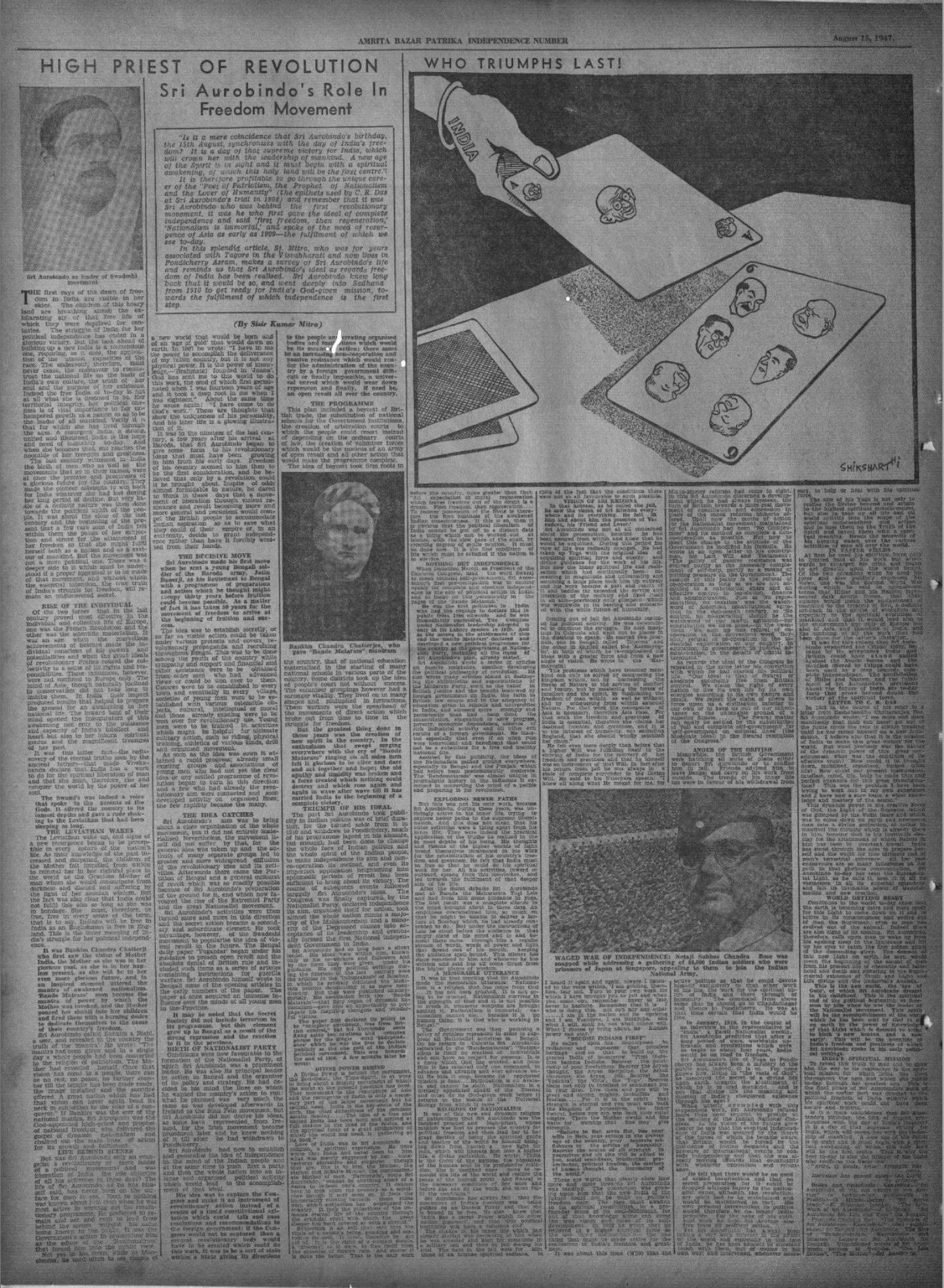
4. Image
The image provided is a low-resolution, grayscale portrait photograph of a man. It is not a chart, graph, or technical diagram containing data. The subject is facing forward, though the image quality is grainy, making specific facial features difficult to discern. He appears to be wearing a light-colored, patterned garment, possibly a checkered shirt or sweater. As this is a photograph of a person and not a data visualization, there are no axes, legends, or numerical data points to extract.
5. Footnote
Sri Aurobindo as leader of Swadeshi movement
6. Paragraph
THE first rays of the dawn of free-
dom in India are visible in her
skies. The children of this hoary
land are breathing airsh the ex-
hilarating air of that free life of
which they were deprived for cen-
turies. The struggle of India for her
political independence has ended in a
glorious victory. But the task ahead of
building up a new India is a tremendous
one, requiring as it does, the applica-
tion of the utmost capacities of the
race. The endeavour, therefore, must
never cease, the endeavour to recon-
struct the national life on the basis of
India's own culture, the truth of her
soul and the purpose of her existence.
Indeed the free India of to-day is not
at all what she is destined to be. Her
territorial integrity, her political one-
ness is of vital importance to her un-
hampered growth as a nation so as to be
the leader of all mankind. Verily it is
that for which she has lived through
the ages. A resurgent India, a strong,
united and illuminated India is the hope
and need of humanity to-day. And
when she becomes that, who reaches the
noontide of her freedom and greatness.
7. Paragraph
the birth of men who as well as the
movements that go in their names, were
at once the pioneer and precursors of
a glorious future for the country. They
made the pioneer attempts to win back
for India whatever she had lost during
her long period of decline. But very lit-
tle of a definite nature was then done
towards the political uplift of the peo-
ple. It was about the close of the last
century and the beginning of the pre-
sent that a few rare sons of India felt
within them the pangs of her subje-
tion and strove for the attainment of
her freedom so that she might fulfili
herself both as a nation and as a savi-
our of mankind. But the movement was
not a mere political one. There was a
deeper side to it which must be under-
stood if a proper appraisal is to be made
of that movement, and without which
the essential intention, the true truth
of India's struggle for freedom, will re-
main an undiscovered secret.
8. Paragraph
# RISE OF THE INDIVIDUAL
Of the two forces that in the last
century proved most effective in the
individual and collective life of Europe,
one was the French Revolution and the
other was the scientific materialism. It
was an age when the marvellous
achievements of Science made the in-
dividual conscious of his powers and
potentialities and when the great ideals
of revolutionary France roused the col-
lectivity to a sense of its rights and re-
sponsibilities. Those influences, however,
were not confined to Europe only. The
mind of Asia, though naturally inclined
to conservatism did not take long to
imbibe them. In India their impact
produced results that helped to prepare
the ground for an awakening in her
national life. The inward bent of their
mind opened the inaugurators of this
awakening not only to the puissance
and capacity of India's intellect and
heart but also to her inherent spiritual
genius and the magnificent treasures
of her past.
9. Paragraph
It was this latter fact-the redis-
covery of the eternal truths seen by the
ancient fathers-that made Viveka-
nanda declare that India has a work
to do for the spiritual liberation of man
and that she must, therefore, rise and
conquer the world by the power of her
soul.
10. Paragraph
The Swamp's was indeed a voice
that spoke in the accents of the
Gods. It stirred the country to its
inmost depths and gave a rude shak-
ing to the Leviathan that had been
sleeping so long.
11. Section Title
THE LEVIATHAN WAKES
12. Paragraph
The Leviathan woke up, and signs of
a new resurgence began to be percep-
table in every sphere of the nation's
life. As their knowledge of the past in-
creased and deepened, the children of
the Mother felt inspired from within
to reinstall her in her rightful place in
the world as the Oraculous Mother of
man whom she would emancipate from
darkness and discord and suffering by
the light of her acosian wisdom. But
the fact was also clear that India could
not fulfill this aim so long as she was
in bondage. She must, therefore, be
free, free in every sense of the term,
that is to say, India will be free in
India as an Englishman is free in Eng-
land. This is the inner meaning of In-
dia's struggle for her political independ-
ence.
13. Paragraph
It was Bankim Chandra Chatterjee
who first saw the vision of Mother
India, the Mother as she was in her
glorious past, as she is in her hap-
less present, as she will be in her
even more glorious future, and in
an inspired moment uttered the
mantra of awakened nationalism.
'Bande Mataram' soon became the
mantra of power by which the
Mother was invoked, and the Mother
poured her shakti into her children
and fired them with a burning desire
to dedicate themselves to the cause
of their country's freedom.
14. Paragraph
Sri Aurobindo called Bankim a Rishi,
a seer, and revealed to the country the
truth of the 'mantra'. He wrote: "The
mantra had been given and in a single
day a whole people had been converted
to the religion of patriotism. The Mo-
ther had revealed herself. Once that
vision has come to a people, there can
be no rest, no peace, no further sham-
ber till the temple has been made ready,
the image installed and the sacrifice
offered. A great nation which has had
that vision can never again bend its
neck in subjection to the yoke of a con-
queror." If Bankim was the seer of the
national mantra, Sri Aurobindo was the
God-appointed high-priest and prophet
of national freedom who delivered the
gospel of dynamic nationalism and
chalked out the main lines of action
for its growth and fulfillment.
15. Paragraph
But was Sri Aurobindo only an evan-
gelist a revolutionary or mere leader
of a political movement? And was
liberation of India the sole objective
of all his activities in those days? The
life of Sri Aurobindo, as he has him-
self said, has never been on the sur-
face for man to see. Next to nothing
was known about him even when he was
most active in working out the revolu-
tionary programme. He preferred to re-
main and act and even to lead from
behind the scenes without his name
being known to the public. It was the
Government's action to preventing him
as the editor of the Bande Mataram
that forced him into the public view.
Not yet in his teens, while so Man-
chester, he used often to use vicious of
16. Paragraph
"Is it a mere coincidence that Sri Aurobindo's birthday,
the 15th August, synchronises with the day of India's free-
dom? It is a day of that supreme victory for India, which
will crown her with the leadership of mankind. A new age
of the Spirit is in sight and it must begin with a spiritual
awakening, of which this holy land will be the first centre."
17. Paragraph
It is therefore profitable to go through the unique care-
er of the "Poet of Patriotism, the Prophet of Nationalism
and the Lover of Humanity" (the epithets used by C. R. Das
at Sri Aurobindo's trial in 1908) and remember that it was
Sri Aurobindo who was behind the first revolutionary
movement. It was he who first gave the ideal of complete
independence and said 'first freedom, then regeneration,'
'Nationalism is immortal,' and spoke of the need of resur-
gence of Asia as early as 1909-the fulfilment of which we
see to-day.
18. Paragraph
In this splendid article, St. Mitra, who was for years
associated with Tagore in the Viswabharati and now lives in
Pondicherry Asram, makes a survey of Sri Aurobindo's life
and reminds us that Sri Aurobindo's ideal as regards free-
dom of India has been realised. Sri Aurobindo knew long
back that it would be so, and went deeply into Sadhana
from 1910 to get ready for India's God-given mission, to-
wards the fulfilment of which turdependence is the first
step.
19. Headline
(By Slair Kumar Mitra)
20. Paragraph
a new world that would be born and
of an 'age of gold' that would dawn on
earth. In 1907 he wrote: "I have in me
the power to accomplish the deliverance
of my fallen country, but it is not any
physical power. It is the power of know-
ledge,-'Brashimatz' founded in 'Jnana'.
God has sent me to this world to do
this work, the seed of which first germi-
nated when I was fourteen years of age
and it took a deep root in me when I
was eighteen." About the same time
he wrote again: "I have come to do
God's work." These are thoughts that
show the uniqueness of his personality.
And his later life is a glowing illustra-
tion of it.
21. Paragraph
It was in the nineties of the last cen-
tury, a few years after his arrival at
Baroda, that Sri Aurobindo began to
give some form to his revolutionary
ideas that must have been growing
in him from his early days. Freedom
of his country seemed to him then to
be the first consideration, and he be-
lieved that only by a revolution could
it be brought about. Inspite of odds
almost formidable in nature, he dared
to think in those days that a move-
ment of liberation through violent re-
sistance and revolt becoming more and
more general and persistent would com-
pel the British people to accommodate
Indian aspiration so as to save what
they could of their empire or, in an
extremity, decide to grant independence
rather than have it forcibly wres-
ted from their hands.
22. Paragraph
Sri Aurobindo made his first move
when he sent a young Bengali sol-
dier of the Baroda army, Jatin
Baserji, as his lieutenant to Bengal
with a programme of preparation
and action which he thought might
occupy thirty years before fruition
could become possible. As a matter
of fact it has taken 50 years for the
movement of freedom to arrive at
the beginning of fruition and suc-
cess.
23. Section Title
THE DECISIVE MOVE
24. Paragraph
The idea was to establish secretly, or
so far as visible action could be taken
under various pretexts and covers, re-
volutionary propaganda and recruiting
throughout Bengal. This was to be done
among the youth of the country while
sympathy and support and financial and
other assistance were to be obtained
from older men who had advanced
views or could be won over to them.
Centres were to be established in every
town and eventually in every village,
societies of young men were to be es-
tablished with various ostensible ob-
jects, cultural, intellectual or moral
and those already existing were to be
won over for revolutionary use. Young
men were to be trained in activities
which might be helpful for ultimate
military action, such as riding physical
training, athletics of various kinds, drill
and organised movement.
25. Paragraph
As soon as the idea was sown it at-
tained a rapid progress; already small
existing groups and associations of
young men who had not yet the clear
idea or any settled programme of revo-
lution began to turn in this direction
and a few who had already the revo-
lutionary aim were contacted and soon
developed activity on organised lines;
the few rapidity became the many.
26. Section Title
THE IDEA CATCHES
27. Paragraph
Sri Aurobindo's aim was to bring
about a close organisation of the whole
movement, but it did not entirely mate-
rialised. Nevertheless, the movement lit-
self did not suffer by that, for the
general idea was taken up and the ac-
tivity of many separate groups led to
greater and more widespread diffusion
of the revolutionary idea and its acti-
villes. Afterwards there came the Par-
tition of Bengal and a general outburst
of revolt which was so readily possible
because of Sri Aurobindo's preparation
of the ground for it, and which now fa-
voured the rise of the Extremist Party
and the great Nationalist movement.
28. Paragraph
Sri Aurobindo's activities were then
turned more and more in this direction
and the secret action became a second-
ary and subordinate element. He took
advantage, however, of the Swadeshi
movement to popularise the idea of vio-
lent revolt in the future. The Bengal
daily paper 'Yugantar' began under his
guidance to preach open revolt and the
absolute denial of British rule and in-
cluded such items as a series of articles
containing instructions for guerilla
warfare. Sri Aurobindo himself wrote in
Bengali some of the opening articles in
the early numbers of the paper. The
paper at once acquired an immense in-
fluence over the minds of all young men
in the Province.
29. Paragraph
It may be noted that the Secret
Society did not include terrorism in
its programme, but this element
grow up in Bengal as a result of the
strong repression and the reaction
to it in the province.
30. Paragraph
BIRTH OF NATIONALIST PARTY
Conditions were now favourable to the
formation of the Nationalist Party, of
which Sri Aurobindo was a prominent
leader. He was also its principal leader
in action in Bengal and the organiser
of its policy and strategy. He had de-
cided in his mind the lines on which
he wanted the country's action to run:
what he planned was very much the
same as was developed afterwards in
Ireland as the Sinn Fein movement, but
Sri Aurobindo did not derive his ideas,
as some have represented, from Ire-
land, for the Irish movement became
prominent later and he knew nothing
of it till after he had withdrawn to
Pondicherry.
31. Paragraph
Sri Aurobindo had now to establish
and generalise the idea of independence
in the mind of the Indian people and
at the same time to push first a party
and then the whole nation into an in-
tense and organised political activity
which would lead to the accomplish-
ment of that ideal.
32. Paragraph
His idea was to capture the Con-
gress and make it an instrument of
revolutionary action instead of a
centre of a timid constitutional agi-
tation which could talk and pass
resolutions and recommendations to
the foreign government; if the Con-
gress would not be captured then a
central revolutionary body would
have to be created which could do
this work, It was to be a sort of state
within a State giving its directions
33. Paragraph
to the people and creating organised
bodies and institutions which would
be its means of action; there must
be an increasing non-cooperation and
passive resistance which would ren-
der the administration of the coun-
try by a foreign government diff-
cult or finally impossible, a univer-
sal unrest which would wear down
repression and finally, if need be,
an open revolt all over the country.
34. Section Title
THE PROCLAMINE
35. Paragraph
This plan included a boycott of Bri-
tish trade, the substitution of national
schools for the Government institutions,
the creation of arbitration courts to
which the people could resort instead
of depending on the ordinary courts
of law, the creation of volunteer forces
which would be the nucleus of an army
of open revolt and all other action that
would make the programme complete.
The idea of boycott took firm roots in
36. Image
The provided image is a low-resolution, grayscale portrait photograph of a person. It appears to be a historical photograph, possibly from a newspaper or archival document, given the grainy texture and monochromatic quality. The subject is a woman facing forward with a neutral expression. She has short hair styled with a distinct, thick braid or headwrap wrapped around the top of her head. She is wearing a dark, high-collared garment. The background is dark and indistinct. As this is a photograph of a person and not a chart, graph, or technical diagram, there are no axes, legends, numerical data, or trends to analyze.
37. Footnote
Bankim Chandra Chatterjee, who
gave "Bande Mataram" mantram
38. Paragraph
the country, that of national education
materialised in the starting of many
national schools in various parts of the
country. Some districts took up the idea
of people's court not without success.
The volunteer groupings however had a
saronger vitality. They lived on in many
shapes and multiplied in formations.
These workers were the spearhead of
the movements of direct action which
broke out from time to time in the
struggle for freedom.
39. Paragraph
But the greatest thing done in
those years was the creation of
new spirit in the country. In the
enthusiasm that swept surging
everywhere with the cry of "Hande
Mataram" ringing on all sides men
felt it glorious to be alive and dare
and act together and hope; the old
apathy and timidity was broken and
a force created which nothing could
destroy and which rose again and
again in wave after wave till it has
carried India to the beginning of a
complete victory.
40. Paragraph
The part Sri Aurobindo took publi-
city in indian politics was of brief dura-
tion, for he turned aside from it in
1910 and withdrew to Pondicherry, much
of his programme lapsed in his absence,
but enough had been done to change
the whole face of Indian politics and
the whole spirit of the Indian people,
to make independence its aim and non-
co-operation its method, and even its
imperfect application heightening into
apocalyptic periods of revolt has been
sufficient to bring about its victory. The
course of subsequent events followed
largely Sri Aurobindo's ideas. The
Congress was finally captured by the
Nationalist Party, declared independence
its aim, organized itself for action, took
almost the whole nation minus a major-
ity of the Mohammedans and a mono-
rity of the Depressed classes into ac-
ceptance of its leadership and eventu-
ally formed the first National indepen-
dent Government in India.
41. Paragraph
Sri Aurobindo had no long been a silent
leader. His ideas were within him, known
only to his co-workers and followers and
by the form they were given under his
guidance. His only political writings dur-
ing the nineteen of the last century were
the articles in the 'Induprakasha' of Bombay,
in which he severely criticized the Medi-
rate politics denouncing it as mere men-
diness. But they were published anonymously. His association with the 'Bande
Mataram'-that fiery organ of dynamic na-
tionalism-gave him an opportunity to pro-
pagate his inspiring thoughts and wonder-
ful visions.
42. Paragraph
The paper first declared its policy to
be "complete autonomy, free from Bri-
tish control," but Mr Ameryhindo soon
knew aside too cautious and complex
phrase for the single word 'independent', which he was the best to declare
publicly as the one goal of the Indian
political movement. This was towards
the end of 1906. A few months later he
wrote:
43. Section Title
DIVINE POWER SEEN
44. Paragraph
A Divine Power is behind the movement,
the Self-Ocean, the Time-Spirit, is at work
to being about a mighty movement of which:
the world at the present juncture has need.
That movement is the resurgence of Asia
and the resurgence of India is only a neces-
sary part of the larger movement but its
central need, India is the key-stone of the
arch, the chief authenticity of the common
Asian destiny......The idea of a free and
united India has been born and arrived at
full stature in the land of the Muslims, and
the spiritual force of a great civilization of
which the world has need, is gathering at
its back."
45. Paragraph
Love of India was to Sri Aurobindo a
religion, a spiritual experience. He once
wrote that India and never been to him
what was merely suggested by her outer
vestures attractive and gorgeous though
they are, She is to Him the Mother, the mother
and minister-Mother, the compassionate,
une mother of man. "Patriotism", wrote Sri
Aurobindo, "cannot be anything short of a
desire to redeem one's country. It cannot
be to look upon the country as a repul-
ture through it may seem so. It feels the
immorality swirling beneath those ruins
with which subjection has overgrown the
country. It feels the pulsations of the im-
mense eternal life of the country through
the aromatic crust with which the great
sleeper has been covered as with a shroud."
Subjerton is an evil that eats into the
vitals of a nation's being, grinding and es-
roding its soul. It numbs therefore he must
rid of it. It is the sight of a subject people,
a 'charm', as it were, to free itself from
the shackles of foreign rule. And sooner it
is done the better. That is the only work
46. Paragraph
WHO TRIUMPHS LAST!
47. Image
The image is a black-and-white political cartoon by Shrikshart Hi. It depicts a hand holding a playing card labeled "INDIA" with a caricature of Mahatma Gandhi on it. The card is positioned above a table. On the table, there is a playing card showing the Ace of Spades, and another card showing the 6 of Spades. The cartoon uses these playing cards to represent India and its leaders, suggesting a commentary on the nation's political landscape. The artist's signature is visible in the bottom right corner.
48. Paragraph
before the country, none greater than that
"All expectation of moral regeneration
which leaves freedom out of the count is a
dream. First freedom, then regeneration...
To recover possession of the State is there-
fore the first business of the awakened
Indian consciousness. If this is so, then it
is obvious that the political liberation of
India cannot be put off to a distant date
as a thing which can be worked out at
leisure, with the slow pace of the snail by
opting degrees of semi caution. It must
be done now. It is the first condition of
life which must be satisfied if the nation is
to survive."
49. Paragraph
NOTHING BUT INDEPENDENCE
When Diwanji Naoroji, as President of the
Calcutta Congress, used the word SWARAJ
to mean colonial self-government, Sir Auro-
bindo's first pre-occupation was to declare
openly for complete and absolute independ-
ence as the aim of political action in India,
and to insist on this persistently in the
pages of the "Balade Mataram."
50. Paragraph
He was the first politician in India who had the courage to declare this in public from 1946 onwards and he was immediately successful. The Congress under Nationalists leadership adopted is only in its Lahore session in 1929. And as the means to the attainment of sis and the 'Hindu Mataram' declared and developed a new political programme for the country as the programme of Nation- allist Party, including all the items of Sri Aurobindo's plan, already stated.
51. Paragraph
Sri Aurobindo wrote a series of articles
on positive restates, another developing
the political philosophy of revolution. He
also wrote many articles aimed at destroy-
ing the shibboleths and superstitions of
the Moderate Party, such as the belief in
British justice and the benefits bestowed by
foreign government on India, the faith in
British law courts and in the adequacy of
education given in schools and universities
in India, and stressed more strongly and
persistently than had been done the
consecutioan, stagnation or slow progress,
poverty, economic dependence, absence of
rich industrial activity and all other evil
results of a foreign government. He thala-
ted especially that even if an alien rule
were benevolent and beneficent that could
not be a substitute for a free and healthy
national life.
52. Paragraph
Assisted by this publicity, the ideas of
the Nationalists gained ground everywhere,
especially in Bengal and the Punjab, which
had before been predominantly moderate.
The 'Randemataram' was almost unique in
journalistic history in the influence it ex-
ercised in converting the mind of a people
and preparing it for revolution.
53. Section Title
EXPLORING NEW PATTERNS
54. Paragraph
But this was not his only work, because
Sri Aurobindo, during these years, was un-
tiringly active in his inner life, trying to
explore newer paths to the supreme illumina-
tion. And this does not mean that his
outer activities were a thing apart from his
inner life. They were indeed the practical
application of the truths he realised in the
inmost depths of his being. His thoughts
and visions of the higher worlds of light
found themselves incarnated in his work
for the rehabilitation of his country's free-
dom and greatness. He tells that India must
be free so that he could do his spiritual
work for her. All his activities, inward or
outward, sprang from this conviction, and
led towards the fulfilment of that deeper
aim of his life.
55. Paragraph
After the Suras debased Sri Aurobindo
mat at Baroda the Mahatma Yoga Leto
and had from him some guidance in yoga.
The first result was a complete silence in
the mind brought about in three days An
emptiness overwhelmed him, so much so,
that he might be unable to deliver a lec-
ture at Bombay which he had already con-
sented to do. But under the instructions of
Leto he stood before the audience in that
empty state of his mind and to and be-
hold there came through him a regular
stream of words, words of power and light
that flowed out of his mouth. Keeping
the audience spell bound. This silence has
since remained in him and whatever he has
written and said has all come direct from
the higher planes of wisdom.
A MEMORABLY LITURGICAL
56. Paragraph
It was in that meeting that Sri Aurobindo
made the memorable utterance: "Nations-
ism is a religion that has come from God
....it has not been crushed. It is not go-
ing to be crushed. Nationalism survives in
the strength of God and it is not possible
to crush it, whatever weapons are brought;
agustus II. Nationalism is immortal; na-
tionalism cannot die, because it is so
human thing, it is God who is working in
Bengal."
57. Paragraph
The Government was then pursuing a policy of ruthless repression in order to suppress all Nationalist activities in Bengal. On his return to Calcutta Sri Aurobindo reiterated in the 'Handemataram': "Nationalism is itself no creation of individuals and can have no respect for persons: It is a force which God has created, and from Him it has received only one command, to advance and advance and ever advance until He bids it stop, because its appointed mission is done...Nationalism is an Avata-ra and cannot be slain. Nationalism is a divinely appointed shakti of the Eternal and must do its God-given work before it returns to the bosom of the Universal Energy from which it came."
59. Paragraph
It was of this new and dynamic religion
of nationalism that Sri Aurobindo was the
inspired prophet and high-priest, whose
mission was first to prepare the country for
political freedom and then lead her to her
great destiny of being the spiritual guide
and teacher of the world by himself bring-
ing down from heaven a new light for
men, which will liberate him into a higher
life, a divine perfection. He wrote: "India
is the Guru of the nations, the physician
of the human soul in its profounder mat-
ters. She is destined once more to re-
mould the life of the world and restore the
peace of the human spirit. And Swaraj is
the necessary condition of her work and
before she can do the work, she must ful-
fill the conditions."
60. Paragraph
Sri Aurobindo has always felt that the movement of India's freedom was being guided by an Unseen Power and that she is bound to be free. He also knew that India has a secret Power which no other nation possesses, and that 'Our political beginning will have a religious end'. The change in his inner life which had already started was dependent on him when he was arrested and kept for sometimes in a solitary cell and then in jail during his trial. The days in the jail were for him
61. Paragraph
spite of the fact that the conditions there were not as all favourable to earn pilgrims,
VISION OF ALL KINSHINA
62. Paragraph
In that Aahram, as he called the jail,
he saw the vision of Sri Krishna every-
where and in everything. He felt in
him and about him the presence of Va-
sudeva, his 'Friend and Lover.'
63. Paragraph
Sri Aurobindo was not at all concerned
about the prosecution: because he had
been assuaged from within and knew that he
would be acquitted. During this period his
view of life was radically changed. He had
taken up Yoga with the original idea of
acquiring spiritual force and energy and
divine guidance for the work of his life.
Now now the inner spiritual life and reali-
sation which had continually been in-
creasing in magnitude and universality and
assuming a large place took him up entirely
and his work became a part and result of
it and besides far exceeded the service and
noeration of the country and fixed itself
in an aim-previously only glimpsed which
was worldwide in its bearing and concern-
ed with the while future of humanity.
64. Paragraph
Coming out of jail Sri Aurobindo resum-
ed his political activity. He was determi-
ned to continue the struggle. He held meet-
ings in Calcutta and went out to places in
the districts to speak. He started two jour-
nals, one in Bengali called Dharma and
the other in English called the Karmayogi-
in', in both of which he re-emphasised his
ideas with a greater force and from a new
angle of vision. He wrote in the Kar-
mayogini:
65. Paragraph
"The problems which have troubled man-
kind can only be solved by conquering the
kingdom within, not by harnessing the
forces of Nature to the service of comfort
and luxury, but by mastering the forces of
intellect and the spirit, by vindicating the
freedom of man within as well as without
and by conquering from within external
Nature. For that work the resurgence of
Asia is necessary, therefore Asia rises. For
that work the freedom and greatness of
India is essential, therefore she claims her
destined freedom and greatness, and it is
to the interest of humanity, not excluding
England, that she should wholly establish
her claim."
66. Paragraph
He felt even more deeply than before that
a higher Will was ruling itself in the
striving of India for the recovery of her
freedom and greatness and that he himself
was an instrument of that Will. In fact after
his return from jail he was always in a
state of complete surrender to the Divine
Will, He said in his Uttarpara speech: "I
knew all along what He meant for me, for
67. Paragraph
As regards the ideal of the Congress he
repeated in the same letter his conviction
with which he had started his political
life. "Our ideal is that of Swaraj or
absolute autonomy free from British
control. We claim the right of every
nation to live its own life by its own
energies according to its own nature and
ideals. We reject the claim of aliens to
force upon us a civilisation inferior to
our own or to keep us out of our inheri-
tance on the untenable ground of a
superior fitness..... The Swaraj matter
can easily be settled by the substitution
of 'full' and complete self-government for
'self-government on colonial lines' (the
Moderate ideal) in the Swaraj resolution
of the Congress."
68. Paragraph
Minto-Morley reforms had come to sight,
in this Sri Aurobindo grasped a develop-
ment which he had always foreseen, the
turn of Britain towards a more real move-
ment of conciliation and concession in
place of the mock reforms hitherto ob-
served. Until now the motto of action
for the Nationalist movement maintained
by Sri Aurobindo had been "No Compro-
mise" and its method as complete a non-
co-operation as possible. But now we
meet this change in the attitude of the
Government he modified his formula. He
wrote in an open letter to his countri-
men, his Last Will and Testament:
The policy of passive resistance was
evoked partly as the necessary comple-
ment of self-help, partly as a means of
putting pressure on the Government. The
essence of this policy is the refusal of
co-operation as long as we are not ad-
mitted to a substantial share and an
effective control in legislation, finance
and administration. Just as 'No repre-
sentation, no taxation' was the waten-
word of American constitutional agita-
tion in the eighteenth century, so 'No
control, no co-operation' should be the
watchword of our lawful agitation-for
constitution we have none-in the twen-
teenth. We sum up this refusal of co-
operation in the convenient word. Refus-
al, refusal or co-operation in the in-
dustrial exploitation of our country, in
education in government, in judicial ad-
ministration, in the details of social in-
tercourse.
69. Section Title
ANGER OF THE BRITISH
70. Image
The provided image is a low-resolution, grayscale photograph that appears to be a historical or archival scan. It features a close-up of a person, likely a man, wearing glasses and a hat. The image is grainy, making fine details difficult to discern. A horizontal measuring stick or ruler is visible in the upper-left portion of the frame, spanning across the image. The background is indistinct and textured. As this is a photograph of a person and not a chart, graph, or plot, there is no quantitative data, axes, or legends to describe.
71. Paragraph
Meanwhile, the British Government
were hatching all sorts of plans either
to deport Sri Aurobindo or to confine
him in jail. Friends advised him to
leave Bengal and carry on his work from
outside. The trends of his inner life
too were in favour of his withdrawal from
72. Footnote
WAGED WAR OF INDEPENDENCE: Netaji Subhas Chandra Bose was
snapped while addressing a gathering of 64,000 Indian soldiers who were
prisoners of Japan at Singapore, appealing to them to join the Indian
National Army.
73. Paragraph
I heard it again and again, always I hear-
ed to the voice within, "I am guiding, there-
fore fear not. Turn to your own work for
which I have brought you to fall and when
you come out, remember never to lose,
never to hesitate. Remember that it is I
who is doing this, not eyes nor any other
......I am in the nation and its uplifting
and I am Vasudeva, I am Narayana, and
what I will, shall be, not what others will.
What I choose to bring about no human
power can stop."
74. Paragraph
"RECOVER INDIANS FIRST."
He called upon his countrymen to
rediscover and repossess that priceless
heritage and on that he build up the
greater India of to-morrow "First there-
fore become Indians Recover the pride-
mony of your forefathers, RECOVER the Aryan
thought, the Aryan discipline, the Aryan
character, the Aryan life, RECOVER the
'Vedanta', the 'Gita', the 'Yoga'. Recover
them not only in intellect or sentiment but
in your lives. Live them and you will be
great and strong, mighty, invincible and
fearless.... For it is in the spirit that
strength is eternal and you must win back
the Kingdom of yourselves, the Inner
Swarm, before you can win back your outer
empire. There the Mother dwells and she
waits for worship that she may give
strength.
75. Paragraph
"Believe in It, serve It, lose your
wills in Hers, your ecstasies in the greater
ego of the country, your separate self-
consciousness in the service of humanity,
Recover the source of all strength in
yourselves and all else will be added to
you, social soundness, intellectual pre-
eminence, political freedom, the mastery
of human thought, the regency of
the world."
76. Paragraph
These are words that clearly show how
more and more inwards Sri Aurobindo
was tending. The conviction was grow-
ing upon him that the new India of the
future could not be built on political
freedom only. The race must awaken
to its spiritual possibilities, to a pro-
founder sense of its soul-realignment, for
out of that knowledge alone can come
the true vision and force of its self-
development. In 1922 he wrote that he
believed in a higher moral force as
the one thing Indianness-the one
thing that must be made active for the
realization of India's freedom and great-
ness.
77. Paragraph
It was about this time (1909) that the
78. Paragraph
active politics so that he could devote
himself exclusively to that other work
of his life, the work for the spiritual up-
lift of India and there through of
humanity. The command from above
came that he should go to Chandanaggar
and throw to Pondicherry. He was at
that time certain that India would be
free.
79. Paragraph
In January, 1914, in the course of
an interview to the representative of
"India", a Tariff Nationalist weekly,
Sri Aurobindo predicted that after a
long period of wars, worldwide up-
heavals and revolutions which were
to begin in about four years, India
would be on road to freedom.
80. Paragraph
Sri Aurobindo's life of Yoga in Pondi-
cherry has always been a mystery to the
public and, indeed, it is so. For home
knows how, living in "the vasta of God",
he mastered the secret of a divine life
upon earth towards the attainment of
which he is no less mankind. And is
not that divine life the meaning and
mission of India's chequered existence
through the ages?
81. Paragraph
While utterly occupied with this stupendous work, Sir Aurobindo refused more than once request to preside at the sessions of the Indian National Con-
gress. As his vision of the future grew clearer he saw that the eventual independ-
ence of India was assured by the march of the forces of which he became aware;
that Britain would be forced by the insalience of Indian demands and the pressure of international events to com-
cede independence and that she was al-
ready moving towards that eventuality
with whatever opposition and reluct-
ance.
82. Paragraph
the fact that there would be no need
of armed insurrection and that no
secret preparation for it could be
dropped without injury to the nation-
als, even though the revolution-
ary spirit had to be maintained and
would be sustained in tact. His
own personal intervention in politics
would therefore be less longer inde-
pendable. For the sake of his spir-
itual work he kept his Ashram also
free from all political action.
Yet he abandoned his 'always'
83. Paragraph
taking a very keen interest in the latter
of the world and especially in the fate
of India, he has kept himself in constant
touch with them, but of course in his
own way, and intervened, whenever accor-
84. Paragraph
mary, to help or bid with his uttermost force.
85. Paragraph
The aim of his Yoga is not only to
realise the Divine beyond and attain
to the highest spiritual consciousness,
but also to take up all life and all
world activity into the scope of the
spiritual consciousness and action
and to base them on the Truth of the
Spirit and invest them with a spir-
tual meaning. Hence the necessity of
his keeping watch over the various
activities of man all over the world.
86. Paragraph
At first he used his spiritual force only
to limited head of his work but after-
wards he enlarged his orbit and began
to act directly upon the world forces.
Of the two occasions when he used his
force and also publicly expressed his
views, one was the Second World War
during which he said in unequivocal
terms that Hitler and his Nazi trans-
sented dark Asiatic forces, that their
success would mean the enslavement of
mankind to the tyranny of evil, a definite
set-back to the course of evolution and
especially to the spiritual evolution of
mankind and that it would lead also to
the enslavement not only of Europe but
also of Asia, and therefore of India, and
the undoing of all the work they had
been done for the later's liberation.
87. Paragraph
It was for this reason that Set Achu-
bindo advocated the Cripps Plan, be-
cause by its acceptance India and
Britain could have stood united
against the Asiatic forces and the
solution offered by Cripps could have
been used as a step towards com-
plete independence. The amibilation
of Hitler and Nazism, and the finis-
ment of Set Achubindo's provisions
about the future of Indin are to-day
facts that prove beyond doubt the
victory of the spiritual force.
88. Paragraph
LETTER TO C. R. DAS
In 1923 in the course of his reply to a
letter from Deshabandhu Chittaranjan Das,
Sri Aurobindo wrote: "I see more and more
manfully that man can never get out of
the futile circle the race is always treading
until he has raised himself on a new fund-
ation. I believe also that it is the mission
of India to make this great victory for the
world. But what predestiny was the nature
of the dynamic power of this great con-
sciousness, what was the condition of its
effective truth? How could it be brought
down, mobilised, organised, turned upon
life? How could our present instruments,
intellect, mind, life, body be made true and
perfect channels for this great transforma-
tion? This was the problem I have been
trying to work out in my own experience
and I have now a sure basis; a wider knowl-
edge and mastery of the secret."
89. Paragraph
This dynamic power is the creative Force
of God, the Light of the Supreme, which
was glimpsed by the Wodit Bear and which
was to come down on earth and newcreative
man into a divine perfection, as rather to
manifest the divinity which is already there
in him, because that is his inherent dev-
ity for the attainment of which Nature in
him has been so constant travel India
has stood through the ages to prepare per-
self and the world for this ultimate end of
man's terrestrial existence. All her past
endevours are so many milestones on her
path to that glorious consummation. Dr
Aurobindo to-day has seen the supramach-
tal Light, as he calls it, seen it in all its
vastness, in all its supernatural splendour,
and felt its invincible power or transfor-
mation and new creation.
90. Paragraph
Conditions in the world to-day show that
the earth is becoming more and more ready
for this Light to come down on it and be
active in its consciousness and evolve out
of man the Superman, even as man has
evolved out of the animal. Indeed there
are also signs of its coming. Mr Aurobindo
therefore calls upon man to wake up from
his agelong sleep in the ignorance and let
up his eyes to catch the first golden glints
of the descending glory. The descent of
this new Light on earth he says would
mean the beginning of the ascent of man
from his present life of obscurity and fail-
hood and death and suffering to the Supe-
mental existence of Truth and Life and
Life divine and the immortal's Ananda.
91. Paragraph
This is the new world, the 'age of
Gold', of which Sri Aurobindo dreamt
in his childhood. This is the spiritual
end of the political beginning as fore-
seen by him when he was the leader of
the Nationalist movement. This again
will be the accomplishment of the work
which he has been sent by God to do
on earth by the power of Knowledge
of that Light which is destined to bring
to birth a new heaven and a new
earth'. This will be the noontide of
India's freedom and greatness of which
Sri Aurobindo spoke in his early politi-
cal writings.
92. Paragraph
INDIA'S SPIRITUAL MISSION
To reveal this truth so men may see and show
him the way to his redemption is the spirit-
ual mission for which India has lived
throughout the ages and which she continues
to-day through her greatest son. This is
the final phase of Sri Aurobindo's work of
which the earlier part was directed to the
political freedom of India without which
his spiritual work could not have been
secure and fruitful.
93. Paragraph
is it a mere coincidence that Sri Auro-
bindo's birthday, the 19th of August, is also
the day of India's independence?
It is a day of great significance for
India, which will crown her with the tender-
ness of mankind. A new era of all human
life is to night and it must begin with a spirit-
ful awakening of wisdom this holy land
will be the first centre. That is why the
Sert to-day is also the Stranger of the Light
who reveals the Veda "Sri".
"Arise O Sages! arise!"
94. Paragraph
അദ്ധ്യായം 1: ആമുഖം
95. Paragraph
Books and Periodicals. Consists of "Sri Aurobindo, his life and work" in Bengali; French-G. Mundle-Hecquet (1946); Hindi-K. Srinivas Iyengar ("The Life Work of Sri Aurobindo"-J. C. Oehler). In English: The Life of Sri Aurobindo His Life and Works in Bengali by Prof. Chintamani Partha Sarathy Sastri published 1st edition Jan.-Feb., 1875.-In Telugu: Sri Aurobindo, His Life and Work in Kannada by K. V. Subba Rao published May, 1932.; in Tamil: Sri Aurobindo, His Life and Work in Malayalam by P. N. Panikkar published July, 1930. Unpublished letters of Sri Aurobindo to disciples are also included. "The Mother". Sri Aurobindo.