
Schools and learning libraries
Odia classroom lessons
Turn an English science lecture into Odia. Match subject vocabulary to classroom handouts and check that each explanation follows the diagram on screen.


AI dubbing
Translate your video from Hindi to Odia while keeping the original speaker's voice.
Upload videoSupports MP4, MP3, WAV and SRT files up to 2 GB or 1 hour.
Inside the dubbing workspace
See the dubbing workflow · Product walkthrough; a language sample is coming soon.
Create an Odia version of an English lecture, Hindi explainer or recorded story. Keep the original speaker's voice and review the translated content for Odia-speaking viewers.
Turn an English science lecture into Odia. Match subject vocabulary to classroom handouts and check that each explanation follows the diagram on screen.
Explain a service application in Odia. Keep document names consistent with the displayed form and review each instruction against the field it describes.
Dub an equipment-repair lesson into Odia. Verify tool names and the order of assembly with an instructor before sharing it with learners.
Give a field demonstration Odia narration. Have a subject reviewer check crop names and spoken measurements against the source instructions.
Create an Odia edition of a cultural documentary. Review local place names, people’s names and quoted passages with a fluent speaker.
Explain a product setup task in Odia. Retain brand names and English control labels where viewers need to recognise them on the device.
Organisations using Sarvam content workflows

Keep the speaker recognisable and shape the Odia version of your Hindi video before you publish.
Choose voice cloning to carry the original speaker's vocal identity from Hindi into the Odia version.
Workflow illustration · Review the result in your workspace
For developers
Create Odia versions of Hindi videos from your application. Upload the source, track the dubbing job and retrieve the finished video and subtitles.
Python SDK · Set SARVAM_API_KEY in your server environment
import os
from pathlib import Path
from sarvamai import SarvamAI

client = SarvamAI(
    api_subscription_key=os.environ["SARVAM_API_KEY"]
)
media = Path("source-video.mp4")

job = client.dubbing.create(
    source_language_code="hi-IN",
    target_language_codes=["or-IN"],
    export_options=["video", "srt"],
    voice_cloning=True,
    num_speakers=1,
    job_name=media.name,
)
client.dubbing.upload(job.data.upload_url, media)
client.dubbing.start(job_id=job.data.job_id)
Translate your video from Hindi to Odia, review the dialogue and download your dub in Sarvam.
Add your Hindi MP4 or MOV video, or MP3 or WAV recording, in the dubbing workspace.
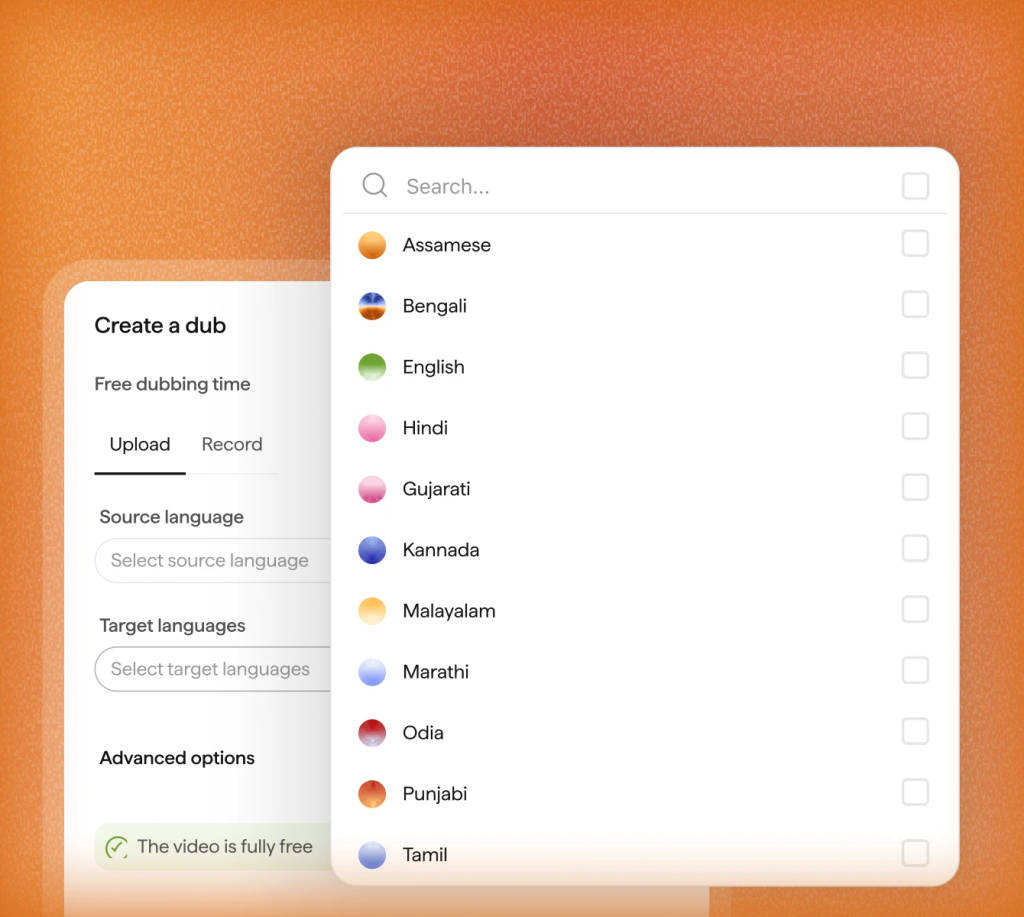
Select Hindi as the source language, Odia as the target, speaker count and voice. Then create the dub.
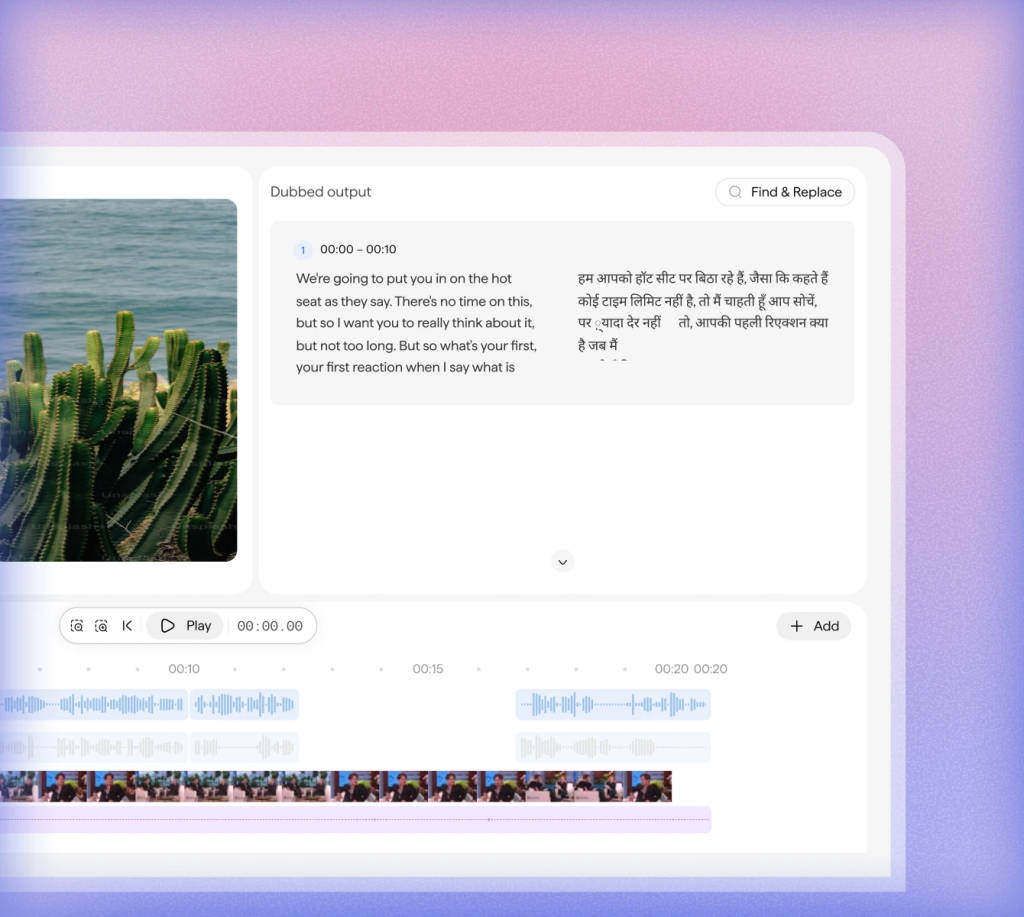
Listen to the Odia version beside the Hindi original. Edit translated lines and regenerate any blocks that need a correction.
Set the audio mix and export the reviewed Odia video. The API also provides separate audio and SRT subtitles.
Upload your Hindi video, choose Odia and select the speaker's voice. Review the translated version in Sarvam's dubbing workspace.
Correct a name or adjust a phrase in the Odia script translated from Hindi. Regenerate that block, listen again and set the audio mix before export.
Yes. Upload the Hindi source in Sarvam, select Odia as a target language, then review the translated dialogue before exporting the Odia version.
Odia is the current English name for the language historically called Oriya. Select Odia in the dubbing workspace; the language code used by the API is or-IN.
AI dubbing translates speech from a Hindi video or audio recording into Odia and generates a new voice track. Sarvam lets you review the translated script, edit individual lines and export the dubbed version.
The workspace accepts MP4 and MOV video, or MP3 and WAV audio, with uploads up to 2 GB. The dubbing API also accepts MKV, WebM, AVI, FLV, WMV and M4A. API size and duration limits depend on your plan.
Yes. Set the number of speakers during setup and choose voice cloning to retain their vocal identities. You can also leave the speaker count and source language on auto-detect. Review each speaker’s lines in the Odia output, especially where voices overlap.
Yes. Edit the translated text in its timestamped block, regenerate that block’s audio and listen again. You can compare it with the Hindi original and adjust the dubbed, original and background audio levels before export.
The workspace exports the reviewed dubbed video. For separate deliverables, the dubbing API can generate video, audio and an SRT subtitle file for Odia. Request the formats you need in export_options when creating the job.
The default Starter API rate is ₹40 per minute of source media for each target language, billed per whole second. A 5-minute video dubbed into one language costs ₹200 at that rate. Editor-enabled API jobs use a different rate. On the Sarvam platform, Content Studio dubbing with the editor is 50% off until 30 Nov: ₹40 per minute on Pay as you go and Pro (standard ₹80), ₹37.5 per minute on Growth (standard ₹75), and ₹36 per minute on Business (standard ₹72), and your first 30 minutes are free when you sign up. In the workspace, check the credit estimate before creating your dub. See the linked documentation for current pricing.
Use hi-IN as the source language code and or-IN as the target language code in Sarvam’s dubbing API. Create a job, upload your media, start processing and poll until completion. Then retrieve the requested exports. You can include multiple target languages in one job.
Product details checked on 21 September 2026. Workspace guide · API limits and pricing
Explore dubbing guides and examples for more Indian languages.
Create your next video in Odia Upload your source video, choose a language and review the new version in Sarvam.
Create your next video in Odia
Upload your source video, choose a language and review the new version in Sarvam.