Verifies the policyholder first
Checks details such as the policy number, registered mobile number or date of birth against your records before it discusses the claim.
Verification 3 of 3
"Thank you. Your details match."

Five steps the agent follows on every claim status call, inbound or outbound.
The agent asks for the details your verification rules require and checks them against your policy records before it shares anything about the claim.
It reads the current stage from your claims system and explains it in plain terms, with the date of the last update and the amount approved where one exists.
When a claim is waiting on the policyholder, the agent explains exactly what is missing, sends an upload link, and records when the policyholder expects to submit it.
Upload your final hospital bill for claim CL-2291 here: claims.example.com/u/CL2291
When the claim moves, your claims system triggers an outbound call through the API. On settlement, the agent tells the policyholder the amount paid, the date and the bank account it went to.
Disputes, partial settlements, rejections and grievances go to a person. The agent transfers the live call to your claims desk.
The agent verifies the caller, reads the claim record, and explains it in the language the policyholder speaks.
Checks details such as the policy number, registered mobile number or date of birth against your records before it discusses the claim.
Verification 3 of 3
"Thank you. Your details match."
Knows whether the claim is cashless or reimbursement, which stage it has reached, the amount claimed and approved, and which documents have arrived.
Claim record Cashless
"Your claim is under review."
Names the document or step holding the claim, such as a missing hospital bill or a surveyor's visit, and sends an upload link so the policyholder can complete it.
Documents 1 pending
"I have sent you an upload link."
Shares only what your policies allow, reads required disclosures in full, and transfers disputes, rejections and grievances to your claims team.
Your rules Active
"Let me connect you to our claims team."
Policyholders describe their claim in their own words, and the agent works out the rest.
If the caller doesn't have the claim number to hand, the agent finds the claim from other details your records hold, such as the policy number or the patient's name.
The agent handles alphanumerics, so policy and claim numbers read out in groups, digit by digit, or mixed with words are captured.
A son can call about his father's claim in Hindi and switch to English for the hospital details. The agent works across Indian languages and follows the caller when they switch.
Describe your claim status call to Genie and it builds the agent for you.
Build your agent
Tell Genie you want a claim status agent. It writes the agent, defines its goals, and lists the scenarios it needs to handle. Keep talking to Genie to edit the agent as you go.
Add your claims FAQs and policy documents as a knowledge base, then connect your policy, claims and settlement APIs as tools. The agent uses them to verify the caller, read the claim and record the outcome.
Connect and launch
Write tests for failed verification, claims under query, missing documents, settled and rejected claims, language switches, interruptions and requests for a person. Run them and review the results before launch.
Rent a phone number from Sarvam or connect your existing telephony provider. KYC is required for rentals.
Answer inbound claim calls and trigger outbound updates by claim stage, then follow outcomes on your dashboard.
Measure results
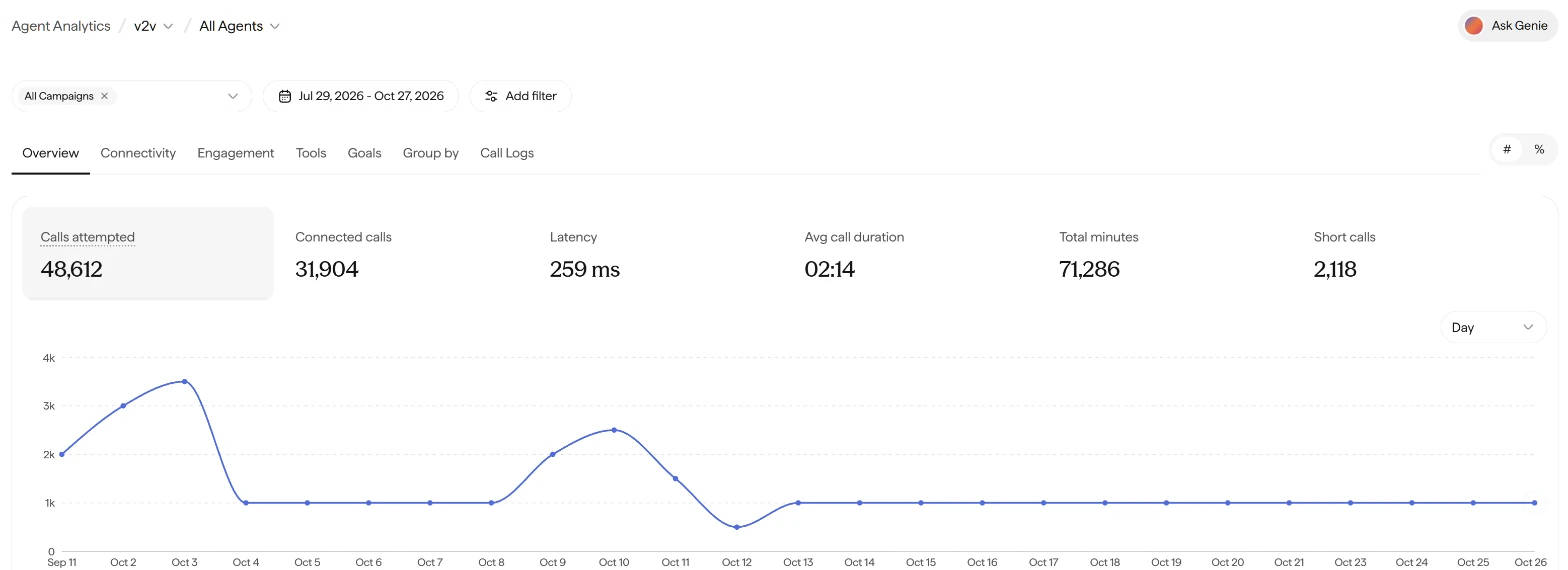
Track calls answered, callers verified, status updates shared, documents requested and calls transferred.
See which calls failed verification, which were transferred, and why.
Break down calls by claim type, stage and language, and compare average call duration across languages.
Each one is on the template's results view from the first call. Read them in the order a call runs.
Every call that reached the customer.
Share of connected calls where the caller passed the verification checks you set.
Calls where the agent read the current claim stage from your claims system and explained it.
Upload links sent for missing documents, and the share uploaded by the date the policyholder gave.
Reasons for transfer, taken from each transcript
See how Voice Agents work across the rest of your calls.
Book, reschedule, and cancel appointments over the phone
Qualify inbound leads before they reach sales
Close pre-approved loan and credit offers over the phone
Answer order, delivery, return, and refund calls in one conversation
Premium due Family floater
Calls policyholders before the due date, confirms intent to renew and sends a payment link.
OutboundNew claim Motor
Registers a new claim, collects incident details and issues a claim reference.
InboundLead LD-4410 Term life
Calls quote requests within minutes, qualifies need and budget, books an advisor slot.
OutboundEvery model on the call runs on Sarvam's own infrastructure, with no outside AI provider involved.
Updated
It can share the current stage, the documents still pending, the amount approved, and for settled claims the payment date and reference, as long as your claims system holds them and your policy allows it. The agent reads this through your APIs during the call, so the update reflects the record at that moment.
Yes, if your policy administration system exposes them through an API. The agent can confirm whether a policy is active, who it covers and when the next premium is due, after the same verification it runs for claims.
You choose the details it asks for, such as the policy number, registered mobile number or date of birth. The agent checks them against your records through an API before it shares any claim details. You also decide what happens when verification fails, such as ending the call or transferring it.
Yes. Your claims system triggers an outbound call through the API at the milestones you choose, such as registration, a missing document, approval or settlement. The agent shares the update and records the outcome.
The agent transfers the live call to your claims team, at a phone number or a SIP address you set. You decide which situations trigger a transfer, for example a rejection, a partial settlement or a formal grievance.
All call data, including policyholders’ personal details, stays in India. Every model on the call runs on Sarvam’s own infrastructure, with no outside AI provider involved. That infrastructure is ISO 27001:2022 certified and SOC 2 Type II attested.
Build the Future of India's AI with Sarvam
Build the Future of India's AI
with Sarvam