Sarvam AI

Automate premium collection with Sarvam Voice Agents

Sarvam Voice Agents call policyholders when their premium is due or an auto-debit fails, tell them the amount and the grace period, and take the payment on the same call.

Policyholders reached before the grace period ends
83%
Calls that end with the premium paid or a date agreed
64%
Payment questions answered without a transfer
78%

How the agent collects a due premium

Five steps the agent follows for every policy with a due or missed premium.

Step 1 of 5

Reach the policyholder

The agent calls from your due list or the moment an auto-debit fails, and confirms it is speaking to the policyholder before it mentions the policy or the amount.

Policyholder Confirmed
Policy TL-1904-2286
Date of birth Matched

Every missed premium gets a call

The agent knows the policy, the amount and the grace period before it dials, and takes the payment while the policyholder is on the line.

Calls when the premium is due or missed

Upload the due list as a campaign, or trigger a call from your payment system the moment an auto-debit fails. Policies paid in the meantime drop out before the next call.

Collection campaign Running

Auto-debit failed Call the same day
Due in 3 days Reminder call
Already paid Skipped
Voice Agent

"Am I speaking with Rakesh Verma?"
Says what is due and by when

Reads the policy number, the premium, the due date and the last day of the grace period from your records, so the policyholder knows exactly what is at stake.

Policy TL-1904-2286 Term life

Mode Monthly
Premium ₹2,450
Grace period ends 20th Nov
Voice Agent

"Please pay by 20th November so your cover stays active."

Takes the payment on the call

Sends a UPI or payment link on WhatsApp or SMS through your own providers, stays on the line while the policyholder pays, and confirms once your payment system shows it received.

WhatsApp Delivered

Hi Rakesh, your premium of ₹2,450 for policy TL-1904-2286 is due. Pay by 20th Nov: pay.example.com/p/TL1904

Voice Agent

"I can see the payment has come through. Thank you."

Records a date when they cannot pay today

If the policyholder needs a few days, the agent notes the date they give and calls back only if the premium is still unpaid. Requests to change the bank account go to your service team.

Payment date Promised

Policyholder said Salary comes on 10th
Will pay on 10th Nov
If unpaid Call on 11th Nov, 10 AM
Voice Agent

"I have noted 10th November. I will call only if the payment has not come through."

Built for how policyholders respond

Most policyholders reply in one of three ways. They thought the auto-debit went through. They can pay only after payday. Or they want to stop the policy. The agent sees their payment history before it dials, so it has an answer for each.

  • I thought it was auto-debited

    The agent tells the policyholder the date the debit failed and the reason your payment system gives, then offers a link to pay now.

  • I can pay after payday

    The agent checks the date falls within the grace period, records it, and calls back only if the premium is still unpaid.

  • I want to stop the policy

    The agent does not argue. It explains what the policyholder would lose from your knowledge base and offers a call with your service team.

Set up your premium collection agent

Describe your premium collection call to Genie and it builds the agent for you.

Build your agent

Shape the conversation

  • Build with Genie

    Tell Genie you want an agent that calls policyholders when the premium is due or missed. It writes the agent, sets its goals, and lists the outcomes it must record. Keep talking to Genie to change the wording.

  • Connect your knowledge and systems

    Add your grace period and lapse rules as a knowledge base. Connect your policy and payment APIs as tools so the agent can read the premium, send the link and confirm the payment.

Connect and launch

Give every call a next step

  • Test every scenario

    Before launch, try the calls most likely to go wrong, like a policyholder who has already paid, one who can pay only after payday, or one who wants to stop the policy.

  • Connects to a phone number

    Rent a phone number from Sarvam or connect your existing telephony provider. KYC is required for rentals.

  • Take it live

    Upload your due list as a campaign, or send failed auto-debits through the API, and the agent calls each policyholder. Track payments and promised dates on your dashboard.

Measure results

See where conversations lead

  • Track every outcome

    Track policyholders reached, premiums paid on the call, payment dates agreed and calls transferred.

  • Why premiums are missed

    See the reasons policyholders gave and which calls ended before the link went out.

  • By mode and language

    Break down outcomes by premium mode, days left in the grace period and call language.

What to measure

Each one is on the template's results view from the first call. Read them in the order a call runs.

  1. Connected calls

    Every call that reached the customer.

  2. Policyholders reached

    Share of policies with a due or missed premium where the agent spoke to the policyholder, by call attempt and days left in the grace period.

  3. Payment commitments

    Share of connected calls that end with the premium paid on the call or a payment date agreed, by premium mode and call language.

  4. Premiums collected after the call

    Premiums paid through the link the agent sent or by the date the policyholder gave, matched against your payment system before the next call round.

Reasons premiums are missed, taken from each transcript

  • Auto-debit failed
  • Low balance
  • Changed bank account
  • Wants to stop the policy
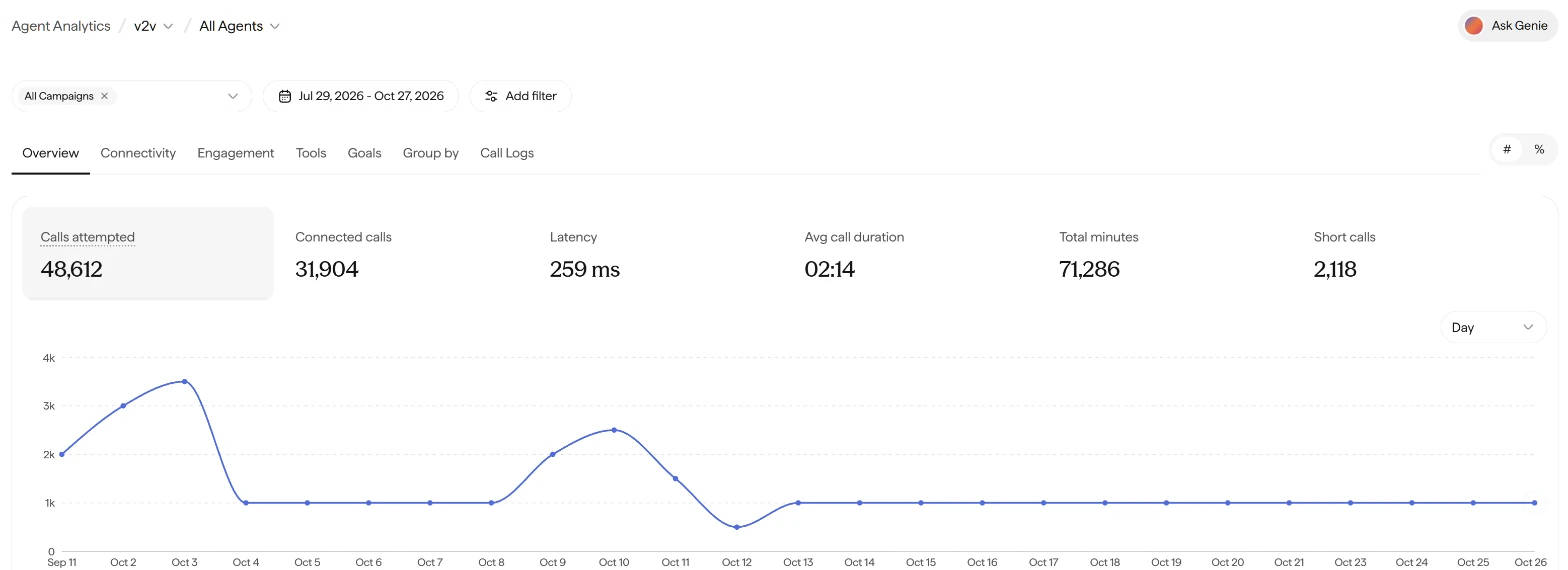
Voice Agents analytics, Overview tab: calls attempted, connected calls, latency, average call duration, total minutes and short calls, with calls per day as a line chart
See all insurance templates

Customer data stays in India

Every model on the call runs on Sarvam's own infrastructure, with no outside AI provider involved.

Visit the Trust Center
  • ISO 27001 certified
    Information security ISO 27001:2022 Certified
  • AICPA SOC 2
    Controls attestation SOC 2 Type II Audited
  • Where call data stays India Including customers' personal details
  • Models on the call Sarvam infrastructure No outside AI provider

Questions about premium collection agents

Updated

How does a premium collection call work?

The agent calls each policyholder with a due or missed premium, confirms who it is speaking to, and states the premium and the last day of the grace period. It answers questions from your knowledge base, sends a UPI or payment link on WhatsApp or SMS, confirms the payment on the call and writes the outcome to your CRM.

Can the agent call when an auto-debit fails?

Yes. Your payment system can trigger a call through the API as soon as a mandate fails. The agent tells the policyholder the date and the reason your system gives, and offers a link to pay that premium straight away.

Can the agent collect the premium payment during the call?

Yes. It sends a UPI or payment link from your payment system through your WhatsApp or SMS provider, stays on the line while the policyholder pays, and confirms once your system shows the premium received.

Does the agent follow our script and disclosures?

Yes. It reads the disclosures your script requires, asks for consent where you set it, and records every call. Requests to stop a policy, change a bank account or discuss surrender go to a person on your team.

Which languages can policyholders use?

The agent works across Indian languages and English. When language switching is on, it follows the policyholder if they change language mid-call.

Where is policyholder data processed?

All call data, including policyholders’ personal details, stays in India. Every model on the call runs on Sarvam’s own infrastructure, with no outside AI provider involved. That infrastructure is ISO 27001:2022 certified and SOC 2 Type II attested.

Build the Future of India's AI with Sarvam